Say the note at the bed.
Paste it at the workstation.
Acuvia records you describing your own work, turns it into text while you carry on, and has it waiting in your browser tab when you get to a computer. You copy it. You paste it. That is the whole product.
No card to start. $5 or ₦5,000 a month after, and you can stop whenever.
You talk three times faster than you type.
Even after the pauses and the fixing, dictation still lands around 55 — and that’s before you count the walk.
Three moments, and you only do work in the first one.
At the bed
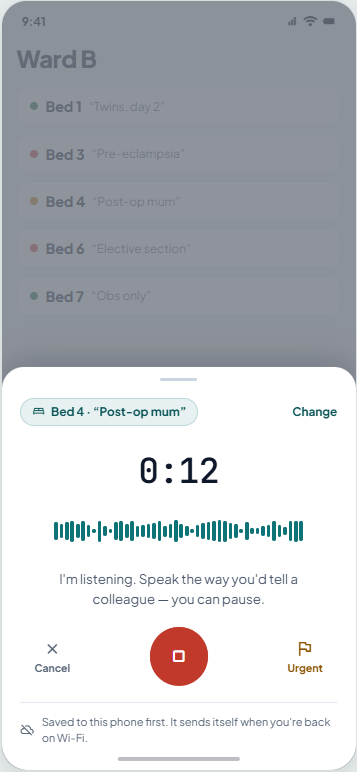
Press record and say the care you gave, the same way you’d type it into your hospital’s system. You name the bed, not the patient.
On the way
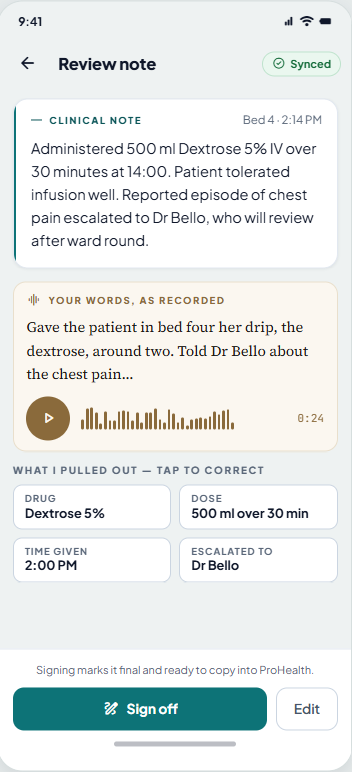
It becomes text without you watching it. If a word came out wrong you tap it and fix it, and it remembers that word for you next time.
At the workstation
Every note synced itself to your browser tab as it finished. Your shift is already there, bed by bed — copy one, or a whole bed’s worth, and paste it into your hospital’s system.
Try the Android app before it reaches Google Play.
Acuvia is on its way to Google Play. Until then you can install it from this page and start recording at the bed today. The browser tab on the computer is where you copy the note into your hospital’s system.
On an iPhone, use Acuvia in the browser tab on a computer.
By the time you get there, it’s already there.
The second a note finishes transcribing it appears in your browser tab — no export, no sending it to yourself, no cable. Sit down, open the tab, and your shift is laid out bed by bed with a copy button on every note. One click, then paste it straight into the hospital’s system.
Nothing to do to make it arrive. Recording it is the only step you take.
Only the text travels. The recording stays on your phone and never reaches the tab.
Took her vitals at half one — BP 130 over 85, temp 37.2. She has vomited twice. I have told the doctor on call.
Vitals repeated at ten to four. BP 124 over 78, settled.
It can tidy a note. It can’t invent one.
Anything on cream paper is exactly what you said, kept word for word. Ask for the tidy version and it changes register, times and abbreviations — nothing else. No finding appears that you didn’t say. Tap any sentence and it shows you the words it started from.
Stacking a whole shift together never rewrites anything. It’s titled what you said today, because that is all it is.
Took her vitals, BP 130 over 85. She’s complaining of chest pain and vomiting since this morning.
Vital signs taken at 09:12. BP 130/85. Patient reports chest pain and vomiting since this morning.
You shouldn’t have to hold the whole shift in your head.
Two things it picks up while you talk — and neither of them invents anything.
The 2 o’clock you promised
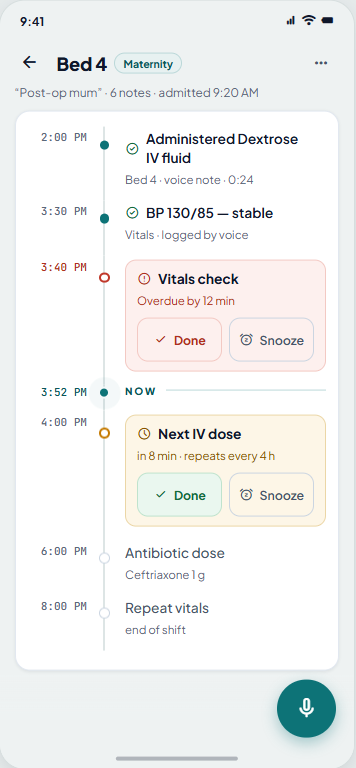
Say a time out loud — recheck her BP at 2, next dose at 14:00 — and it becomes a reminder before you’ve left the bed. Only times you actually said, never something you merely implied.
Handover, already written
At the end of the shift it lays one bed out in SBAR, using only the sentences you said about that bed. It arranges; it doesn’t author. Where you said nothing, the heading stays empty instead of being filled in on your behalf.
The limits, before you find them yourself.
Every one of these is a decision, not a missing feature. Ask us about any of them.
It doesn’t touch your hospital’s system
No integration, no login to your EMR, nothing written on your behalf. You copy and you paste, and the entry is yours.
It is not a bedside recorder
You are the one being recorded. When a second voice turns up in the audio it becomes a gap, not a transcript, and it asks you to say it yourself.
It doesn’t summarise a patient
No discharge summaries, no inference, no plausible sentence bridging a gap in what you said. If it isn’t in the recording, it isn’t in the note.
With no signal there’s no transcript yet
Recording works anywhere. The words arrive when you next have a connection, and until then you can play it back and type from it.
Acuvia’s archive is not the patient’s record
The record lives in your hospital’s system. What sits here is your own notebook of the last few shifts — if you never pasted it in, it was never documented.
Where the audio goes, in plain words.
The recording stays on your phone and deletes itself after 48 hours — sooner if you delete it, and deleting it doesn’t delete the note. To turn it into words it does have to reach us: it travels encrypted, gets transcribed, and is thrown away without ever being written to our storage. Only the text stays, and only the text reaches your browser tab.
A bed, a ward and a time — that’s all we hold. It still isn’t anonymity, which is why leaving names out is worth the habit.
One price, paid by you, cancelled by you.
Fourteen days free, no card asked for. After that it’s a monthly payment by card, or by bank transfer in naira. In dollars it renews by itself. In naira you pay one month at a time, and we email you before it ends. If a payment fails while you’re on the floor the microphone stays open — we’ll sort it out when your shift is over, not at a bedside.
If you stop paying, recording closes. Everything you’ve already written stays readable and copyable for as long as it’s here.
or ₦5,000 a month, if you pay in naira
- 300 minutes of dictation a month, about 1,000 notes
- Phone and browser tab, in sync
- Card, or bank transfer in naira
- Cancel from the app, no phone call